Messier 106
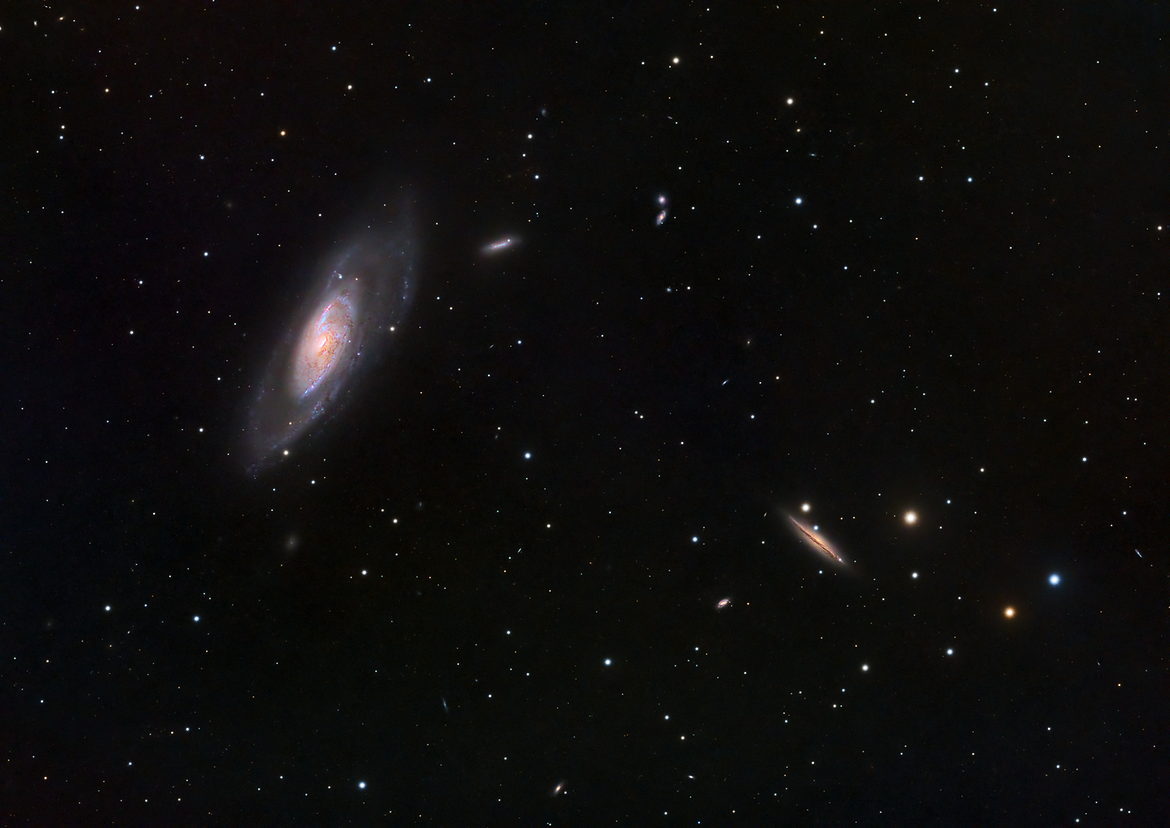
Messier 106, here seen as the largest galaxy, is a spiral galaxy located in constellation Canis Venatici ("Hunting Dogs") located at about 22 to 25 million light years from Earth and whose diameter spans for about 135'000 light years. It was discovered by the French astronomer Pierre Méchain in July 1781 - the small details need a large telescope to resolve but due to its brightness, a small telescope can spot it, being best observed during May in the northern Hemisphere.
M106 has a distint S shape, formed by the nucleus and its pair of arms but notably, this galaxy has an extra pair of arms (not seen in this photo), made not of stars but of gas. This extra pair of arms is not located along the galaxy plane but rather intersects it.
But where does it come from?
Like many spiral galaxies, M106 has a supermassive black hole in its heart but unlike our Milky Way, which only pulls the surrounding gas occasionally, M106 is actively devouring it. The extra arms appear to be an indirect result of jets of material produced by the intense churning of matter around the black hole. As these jets travel through the galactic matter they disrupt and heat up the surrounding gas, which in turn excites the denser gas in the galactic plane and causes it to glow brightly.
This whole image is sprinkled with galaxies, being the largest NGC 4217, NGC 4248 and NGC 4226 (decreasing size). Some of them are companions to M106 but the majority is far away in the cosmic background. The annotated version can be found here.
Canes Venatici constellation represents the hunting dogs of Boötes ("The Heardsman"), represented by the neighbouring galaxy - these two hunting dogs are Asterion and Chara.
This photo was taken at Barcarena, Portugal (Bortle 8) in February 2023, in a total of almost 27 hours of LRGB.
Technical details as follows:
LUM: 210 x 120' 2023.02.26
RED: 169 x 120' 2023.02.01 | 2023.02.16
GREEN: 216 x 120' 2023.02.01 | 2023.02.16
BLUE: 209 x 120' 2023.02.01 | 2023.02.16
SW EQ6-R Pro | TS Optics Triplet APO 800/115 | TS Optics TSFLAT2 0.79x | QHYCCD 268M | Optolong LRGB | RBFocus Gaius-S | RBFocus Myrrdin 2.3